
The question is not already resolved by the preceding context.
Overview
Questions evoked by scientific figures
A figure in a scientific paper can raise questions that its caption and the preceding text have not yet answered. We extend Questions Under Discussion (QUD) to study these questions and how they connect a figure to the paper’s argument.
We introduce MQUD, a dataset of 1,250 questions from 56 scientific papers, including 708 questions annotated by the papers’ original authors. The questions concern visual observations whose scientific relevance is explained later in the paper. Each is paired with an answer and supporting text.
We ask models to generate questions with three properties, defined in the paper:
It concerns the paper’s research claims and is addressed later in the paper.
It arises from an observation in the figure.
Representative questions
Questions from figure QA benchmarks
These examples illustrate the kinds of questions in ChartQA, SPIQA, and MQUD.
-
ChartQA
value extraction
What is the difference in value between Lamb and Corn?
-
SPIQA
figure lookup
Which pooling method is the most accurate for the AFEW database?
-
Multimodal QUD
figure-text inquiry
What are the implications of the middle panel’s shape on dimensional utilization?
IsoScore: Measuring the Uniformity of Embedding Space Utilization
What are the implications of the middle panel's shape on dimensional utilization?
Figure and context
The three point clouds occupy the same two-dimensional space. Their shapes differ because variance becomes increasingly concentrated along one axis.
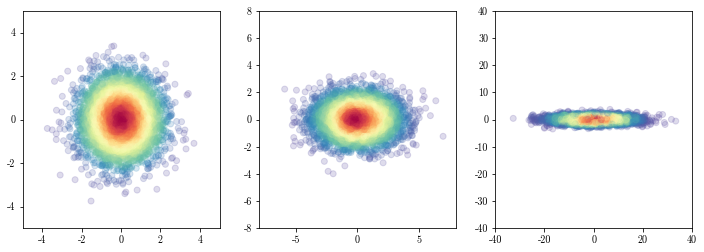
IsoScore, Figure 3. Gaussian samples with covariance diag(x, 1), where x = 1, 3, and 75 from left to right.
Question
What are the implications of the middle panel's shape on dimensional utilization?
Interpretation
The middle cloud uses about 1.61 dimensions under the paper’s dimension-use heuristic. It spreads along both axes, but unequally. This estimate describes how uniformly the space is used; the ambient space is still two-dimensional.
| Panel | x | Dimensions used |
|---|---|---|
| Left | 1 | 1.9996 |
| Middle | 3 | 1.6105 |
| Right | 75 | 1.0281 |
Section 4.2 interprets the middle case as using between one and two dimensions. The estimate comes from the paper’s definition of dimension use.
Question from this site’s MQUD example 34. Caption, context, and explanation adapted from the IsoScore paper.
Model experiments
In our experiments, open-source vision-language models such as Qwen 3.5 mostly ask questions answerable from the figure alone. Fine-tuning on MQUD helps the model generate inquisitive questions about the figure’s role in the paper’s argument. The paper describes the training and evaluation; the dataset card documents the released data.
Related projects
QSalience predicts how much a question’s answer would help a reader understand a text. QUDeval evaluates generated QUDs, and our QUD parser represents dependencies between sentences through questions and answers.
The dataset
Download the JSONL for a flat table of questions, figures, and paper passages. The Hub viewer groups the same information into nested fields.
- Questions
question,answer,question_type, anddifficulty. Each answer is extracted from the paper.- Figures
imagegives the image path.paper_title,paper_abstract, andfigure_captionsupply the context.- Evidence
source_textandsource_paragraphscontain the supporting passages. Usepaper_idto group questions from the same paper.- Split
- All 1,250 examples are in the Hub’s
trainsplit; the release has no separate test split.
Read one questionPython
Uses the Python standard library.
import json
from urllib.request import urlopen

revision = "295b4efc36226ad19429edcd4bccc151b72971d0"
url = (
    "https://huggingface.co/datasets/lingchensanwen/mqud/"
    f"resolve/{revision}/data/mqud.jsonl"
)
with urlopen(url) as response:
    row = json.loads(response.readline())

print(row["id"], row["paper_id"])
print(row["question"])
print(row["answer"])
print(row["image"])
The image value is a path in the dataset repository.
Source
BibTeX
@misc{mqud2026,
  title={{Multimodal QUD: Inquisitive Questions from Scientific Figures}},
  author={Wu, Yating and Rudman, William and Govindarajan, Venkata S and Dimakis, Alexandros G. and Li, Junyi Jessy},
  year={2026},
  eprint={2604.23733},
  archivePrefix={arXiv},
  primaryClass={cs.CL},
  url={https://arxiv.org/abs/2604.23733}
}